
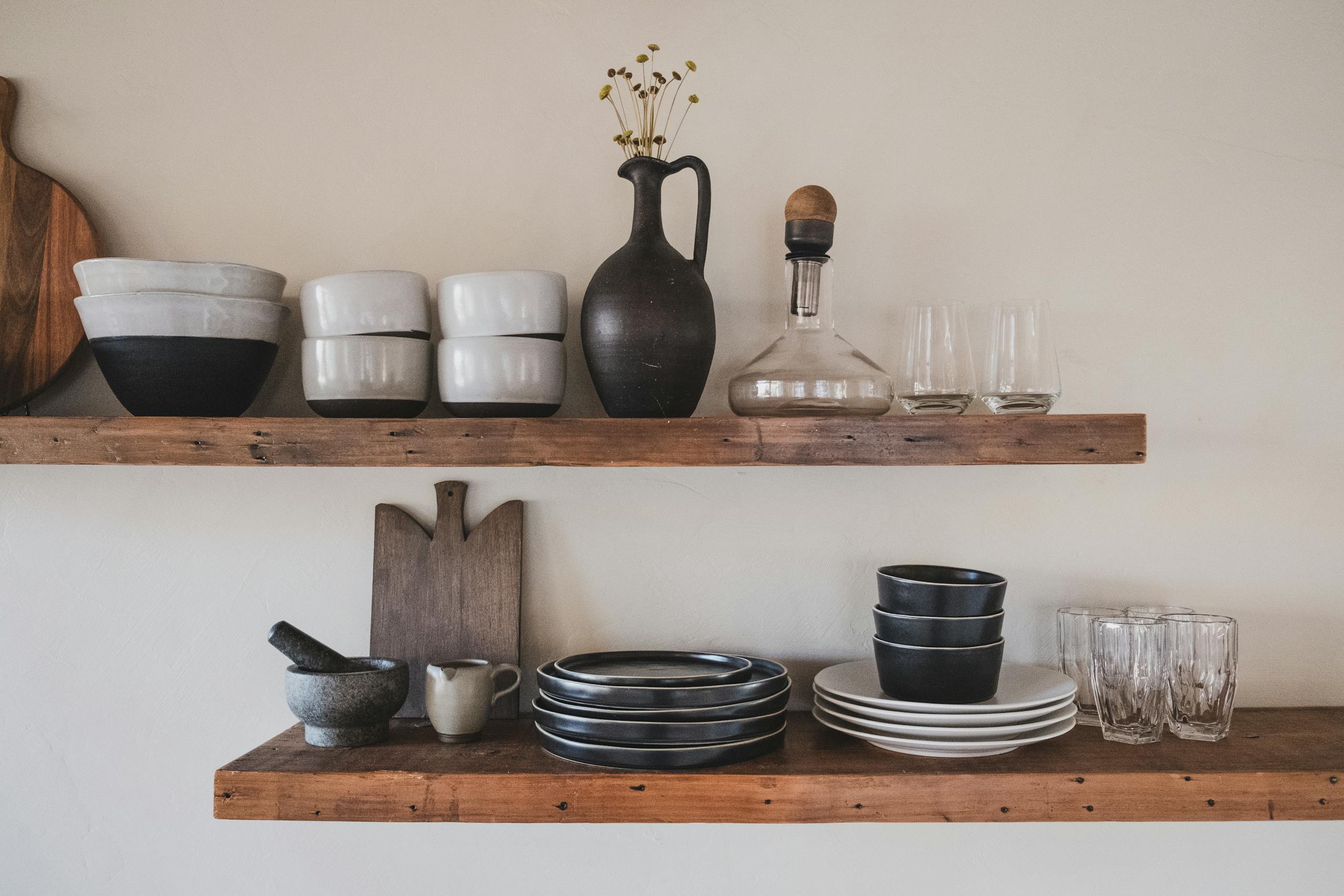
The Peaceful Cottage Paradox: When Beautiful Spaces Still Feel Overwhelming
I enjoy scrolling through Pinterest for beautiful cottage home design ideas. However, I’ve learned to keep in mind that the styled photos aren’t meant for “living” but to inspire.
This post isn’t for everyone. If you love constantly styling your home and it brings you joy—keep doing that! I’m in that camp and enjoy curating and styling my spaces on a regular basis.
Some people are perfectly happy with clutter and creative chaos, and there’s nothing wrong with that. But if you’re someone who loves cottage style AND finds that clutter makes you stressed? If you’re exhausted trying to make your cottage look like the homes you see on Instagram and Pinterest? If you’re frustrated comparing your real life to those perfectly curated feeds? This one’s for you.

This post contains affiliate links. If you purchase through these links, I may earn a small commission at no extra cost to you.
Because here’s what I’ve learned:
I’ve always loved styling my home—the vintage books artfully stacked, the pottery collections thoughtfully displayed, the pillows, plants, and little vignettes that give every corner a story. Creating that cozy, cottage look has always brought me joy.
But somewhere along the way, it started to feel like I was a stuff manager. A job I didn’t sign up for! Every time someone sat on the couch, they would be left looking crumpled and messy. Too much “stuff” left me overwhelmed and exhausted on cleaning day.
The spaces looked curated, but they didn’t feel easy to live in.
That’s when it clicked: I don’t want to give up styling—I just want it to be more purposeful. I want a home that feels beautifully lived in, not endlessly maintained. A space that looks good because it’s thoughtfully designed, not because it’s constantly reset.
I want to feel at ease when we’re actually living in it—to know that if someone knocks on my door unexpectedly, I can happily welcome them in. Not “give me twenty minutes to make it presentable,” but “come on in, this is us.”
Every evening became a styling session. Every morning required “putting things back.” I was constantly managing, arranging, curating. The cottage looked peaceful in photos, but maintaining it was anything but.

That’s when I realized: Pinterest-perfect doesn’t mean peaceful. It means constant work (which I always enjoyed, until I didn’t!).
As a registered nurse for 37 years, I understand what chronic stress does to the body. But it took me too long to connect my constant low-level tension to the daily burden of restyling my cottage after normal life happened.
Today I’m sharing what I learned about the difference between cottage style that’s beautiful AND sustainable, how “magazine-ready” creates hidden exhaustion, and the shifts that helped me create a home that can be LIVED IN without constant maintenance.
Because your cottage should restore you, not require you to restore IT every single day.
My cottage looked peaceful. But it didn’t FEEL peaceful.
That’s when I realized: You can have the most beautiful cottage style in the world, but if it feels cluttered to you, your nervous system will never truly calm down.
In hindsight, I wish it hadn’t taken me so long to connect my home environment to my constant state of overwhelm.
The uncomfortable truth? Clutter isn’t just visual mess—it’s stealing your peace, even in your beautifully decorated cottage.
Today I’m sharing what I learned about why cottage clutter feels different (and often worse), how it affects your nervous system, and the gentle steps that helped me create a home that’s beautiful AND actually peaceful.

The Cottage Clutter Trap
Here’s the thing about cottage style: it’s EASY to confuse intentional coziness with actual clutter.
Cottage aesthetic celebrates:
- Collections (vintage finds, pottery, books)
- Layers (throws, pillows, textiles)
- Display (open shelving, vignettes, styling)
- Abundance (plants, flowers, décor)
All of this is beautiful! But it creates a dangerous trap:
We can’t tell where “charming cottage abundance” ends and “clutter that’s overwhelming us” begins.
That stack of vintage books? Decorative or just piled there because you don’t know where else to put them?
That basket of throws? Cozy styling or actually three blankets you never use stuffed in there to hide them?
Those open shelves displaying pretty things? Intentional styling or just all your stuff on display because you have no storage?
Don’t confuse clutter with “cottage style” .

Why Clutter Triggers Your Nervous System (Even When It’s Pretty)
Research shows that clutter doesn’t just look messy—it actively stresses your brain and body.
The Science:
Elevated cortisol levels have been linked to cluttered surroundings. Women—already juggling mental and emotional load—report higher cortisol throughout their day in cluttered homes compared to organized spaces.
73% of people feel overwhelmed when their home is untidy, and over 80% experience anxiety or stress connected to clutter.
Visual clutter can reduce information processing and productivity by up to 30%.
The typical American home holds around 300,000 items, and 80% admit feeling stressed by clutter.
What This Means for Your Cottage:
Every surface covered in décor = your brain processing 300,000+ visual inputs every time you look around.
Every open shelf displaying collections = constant reminders of things to dust, maintain, organize.
Every beautiful vignette hiding practical clutter = cognitive dissonance that keeps your nervous system on edge.
Your brain knows. Even if your Instagram followers think it looks perfect, your nervous system recognizes chaos.

The Cottage-Specific Clutter Problems
Problem 1: “But It’s Decorative!”
The trap: We keep things because they look cottage style, not because we actually use or love them.
Reality check questions:
- Do you dust it regularly, or does it collect dust?
- Does seeing it bring joy, or do you not even notice it anymore?
- If it disappeared tomorrow, would you miss it?
If the answer is no, it’s clutter—even if it’s vintage, even if it’s pretty.
Problem 2: Open Shelving Overwhelm
The cottage aesthetic loves: Open shelving displaying beautiful dishes, books, pottery.
The reality: Open shelves require CONSTANT curation. Everything is always visible. Dust settles. Things look messy quickly.
This creates: A space that needs to “perform” all the time instead of just… existing peacefully.
Problem 3: “Cozy Layers” That Suffocate
The cottage aesthetic loves: Multiple throws, pillows, textiles creating cozy layers.
The reality: You have 8 throw pillows on your bed but use 2. You have 5 blankets on your sofa but always reach for the same one.
This creates: Visual and physical clutter that you move around constantly instead of actually relaxing with.
Problem 4: Collections That Own You
The cottage aesthetic loves: Vintage collections, thrifted finds displayed with pride.
The reality: That collection of vintage teacups looked charming when it was 5. At 30, it’s overwhelming, never gets used, and you feel guilty about getting rid of any because “it’s my collection.”
This creates: Possessions you maintain out of obligation, not joy.
Problem 5: The Storage-Free Cottage
The cottage aesthetic loves: Everything visible, nothing hidden, open and airy.
The reality: You need closed storage. You need places to put things OUT OF SIGHT. You need drawers, cabinets, closets that work. Often this requires some creative solutions in older or smallish homes!
This creates: All your practical life items shoved in baskets “styled” on shelves, creating hidden chaos.

How Cottage Clutter Affects Your Nervous System
Your home environment directly impacts your ability to stay calm.
Visual clutter floods your senses with constant input. Your brain tries to process everything it sees. With cottage-style abundance, that’s HUNDREDS of objects in one room.
Decision fatigue builds when things don’t have homes. “Where should I put this?” becomes an exhausting daily question.
The emotional load increases because YOU feel responsible for maintaining all this beauty. It’s not just mess—it’s YOUR aesthetic that needs upkeep.
The freeze response happens when you’re so overwhelmed by clutter you can’t even start addressing it. You just… live with it, feeling stressed.
This constant low-level stress keeps your body in fight-or-flight mode, even in your supposedly peaceful cottage sanctuary.
The Shift: From Cottage Aesthetic to Peaceful Cottage Living
Here’s what changed for me:
I realized true cottage living isn’t about having all the pretty things. It’s about creating actual peace.
The historical cottage wasn’t cluttered with décor. It was SIMPLE. Functional. Beautiful, yes, but with purpose.
Cottage style often prioritizes:
- ❌ Looking cottagecore
- ❌ Having the aesthetic
- ❌ Creating the vibe for photos
True cottage living prioritizes:
- ✅ Actual peace
- ✅ Functional beauty
- ✅ Space to breathe
- ✅ Ease of living
I had to get honest: Was I creating a cottage, or a cottage-themed museum that stressed me out?

3 Gentle Steps to Declutter Your Cottage (Without Losing the Charm)
Step 1: The “One Surface” Reset (10-15 minutes)
Choose one surface that catches your eye daily:
- Your nightstand
- Kitchen counter
- Coffee table
- Entryway table
Set a timer for 10-15 minutes and gently sort:

Keep only:
- Things you use daily (lamp, clock, current book)
- ONE decorative item you truly love (not 5)
- Functional necessities
Everything else:
- Donate (the vintage item you never loved)
- Store (seasonal décor that’s not currently relevant)
- Relocate (belongs in another room)
- Discard (broken, dusty, forgotten)
The result: One clear, intentionally styled surface that lets your brain REST when you look at it.
This small action can literally drop your cortisol levels. Studies show even a cleared surface becomes a visual sanctuary your nervous system recognizes.
Celebrate this calm. Stand there. Look at it. Feel how different it feels.
Step 2: Create “Homes” for Cottage Essentials
The cottage clutter problem: Things wander. You set something down “just for now” and it lives there forever.
The solution: Assign permanent, beautiful homes for daily items.
In your cottage, this looks like:
Entryway:
- Keys → vintage dish or hook by door
- Mail → one designated basket (sorted weekly)
- Shoes → bench with storage underneath or basket
Living Room:
- Remote controls → decorative box on coffee table
- Throws → one beautiful basket (keep only 2-3)
- Current reading → one stack limit on side table
Kitchen:
- Daily dishes → easily accessible cabinet (not decorative display)
- Cooking tools → drawer or crock, not countertop
- Papers → one inbox, cleared every 3 days, throw junk mail out immediately
Bedroom:
- Jewelry → vintage tray or box (not scattered)
- Tomorrow’s clothes → designated chair or hook
- Nightstand → only 3 items allowed
Why this works: When things have permanent homes, you stop making decisions moment to moment. Your brain can rest.
Cottage tip: Make these “homes” beautiful. Vintage crocks, pretty baskets, antique trays. Function doesn’t have to sacrifice aesthetic.

Step 3: The “Cottage Edit” – 3 Questions
For every decorative item in your cottage, ask:
1. “Do I genuinely love this, or do I just think it looks cottage style?”
- If you bought it because “that’s cottage style” but don’t actually love it → release it
2. “Does this bring me peace, or does it create work?”
- If it needs constant dusting, rearranging, or makes the space feel busy → consider letting it go
3. “If I were styling this room from scratch today, would I choose this?”
- If no → it’s okay to release it, even if it cost money or was a gift
Apply this to:
- Collections (keep your favorites, release the rest)
- Open shelf displays (curate ruthlessly)
- Decorative pillows (keep 2-3 you actually use)
- Throws (one per seat, maximum)
- Vignettes (one item can be more powerful than seven)
The goal: Every item in your cottage earns its place by bringing genuine joy or serving genuine function.

My Cottage Decluttering Journey
What I released:
From my living room:
- 8 decorative pillows → kept 4, I like to keep a few covers put away to rotate them seasonally
- 4 throws → kept 2
- 12 vintage books on coffee table → kept 3 favorites, rest on actual bookshelf
- 20+ items on open shelves →After restyling those open shelves more times than I can count, I finally realized they just felt too busy with 20+ little pieces on display. So, I ended up moving the top of my vintage hutch upstairs—now it holds books and plants—and kept the simpler cabinet base in the dining room for a cleaner, more minimal look.
From my kitchen:
- 15 vintage mugs → kept 6 favorites, donated rest
- Decorative items on counters → moved to closed cabinet (counters now clear)
- 3 baskets of “stuff” → sorted, most donated/relocated
From my bedroom:
- 6 quilts → kept 3, 2 in storage at end of bed
- Vintage items on every surface → kept 3 most loved, rest stored or donated
What happened:
- ✅ My cottage STILL looks decorated & styled
- ✅ But now it feels CALM
- ✅ I can actually relax in my spaces
- ✅ Cleaning takes 1/3 the time
- ✅ My nervous system isn’t constantly processing visual input
- ✅ I appreciate the items I kept SO much more
The paradox: My cottage is MORE beautiful now with LESS stuff.
Because when every item matters, beauty stands out. When you have 47 things competing for attention, nothing stands out.

Designing Your Cottage for Peace (Not Just Pinterest)
New rules I follow:
Visual Rest Zones
- Every room needs at least one completely clear surface (nightstand, one counter, one shelf)
- This gives your eyes and brain a place to rest
The One-In-One-Out Rule
- New decorative item comes in = one goes out
- Keeps cottage from becoming cluttered again
Closed Storage is Your Friend
- Embrace cabinets, drawers, closets
- Not everything needs to be on display
- Hidden storage does not equal less cottage style
Curate, Don’t Accumulate
- Collections should be DISPLAYED, not STORED
- If it’s boxed up “for someday,” donate it or sell it
- Keep only what you can beautifully display and maintain
The Sunday Reset
- Every Sunday: 15 minutes returning things to their homes
- Prevents clutter from building
- Maintains the peace you’ve created and starts your week out on a calm note!

Cottage Décor That Doesn’t Create Clutter
Instead of:
- 20 small decorative objects → 3 larger, meaningful pieces
- Open shelves full of stuff → Mix of open (curated) and closed (storage)
- Collections displayed everywhere → ONE collection, beautifully displayed, rotated seasonally
- Baskets hiding clutter → Baskets with ONLY their designated contents
- Decorative pillows you move daily → 2-3 you actually use
Embrace:
- Negative space – Empty wall space is beautiful
- Clear surfaces – One perfect vase on a table, nothing else
- Closed storage – Vintage cabinets, antique chests, painted cupboards
- Functional beauty – Things you use AND love
- Quality over quantity – One beautiful throw beats five mediocre ones

The Nervous System Connection
Remember: Your home environment directly affects your stress levels. Your cottage should SUPPORT your nervous system, not activate it.
Clutter activates stress because:
- It signals “incomplete tasks”
- It overwhelms visual processing
- It creates decision fatigue
- It generates guilt (“I should organize this”)
- It prevents true rest
A peaceful cottage:
- Clear surfaces signal “nothing needs doing”
- Curated beauty brings actual joy
- Everything has a home (no decisions needed)
- You can REST, not maintain constantly
- Your nervous system recognizes: “I’m safe. I can relax here.”
This is why decluttering isn’t just organizing. It’s a nervous system practice.

Addressing the Guilt
I know what you’re thinking:
“But that vintage pitcher was $15 at the thrift store!” “But my grandmother gave me that collection!” “But I might need it someday!” “But it’s PART of cottage style!”
Here’s permission:
You can release things that:
- Were gifts but don’t bring you joy
- Cost money but don’t serve you
- Are “cottage style” but create stress
- You thought you’d use but don’t
- Look good in photos but exhaust you in real life
Your cottage should serve YOUR peace, not an aesthetic ideal.
The goal isn’t a minimalist cube. The goal is intentional coziness that actually feels cozy, not overwhelming.
🛒 Shop: Create Peaceful Cottage Storage
Functional + Beautiful Storage:
- [Vintage-Style Storage Baskets] – Natural materials, cottage aesthetic
- [White Painted Storage Cabinet] – Closed storage that looks cottagecore
- [Decorative Storage Boxes] – Pretty enough to display, functional enough to hide
- [Under-Bed Storage Bins] – Out of sight, maximum space
- [Over-Door Organizers] – Hidden storage in closets
- [Drawer Dividers] – Organize without more containers
- [Label Maker] – Makes finding things easy (less frustration)
Decluttering Tools:
- [Large Donation Bags] – Make the process easier
- [Timer] – For 15-minute declutter sessions
- [Storage Containers Clear] – See what’s inside
- [Stackable Bins] – Maximize closet space
🌿 The Stillness Before the Shift Method
If clutter and overwhelm have been stealing your peace for a long time, my Stillness Before the Shift Method includes practices for:
- Creating peace in your physical space
- Calming your nervous system
- Releasing without guilt
- 90 days of gentle resets
Because sometimes clutter is just the visible symptom of deeper overwhelm.
Learn more about Stillness Before the Shift
Your Gentle Cottage Decluttering Plan
This week:
- Clear ONE surface completely (10 minutes)
- Notice how it makes you feel
- Don’t add anything back for 3 days
This month:
- Choose 3 surfaces to keep clear always
- Assign “homes” for 5 daily-use items
- Release 10 decorative items you don’t love
This season:
- Go room by room with the “Cottage Edit” questions
- Create closed storage solutions
- Establish Sunday reset routine
Small steps. Gentle progress. Real peace.
The Paradox Resolved
The uncomfortable truth: My cottage became MORE beautiful when I removed things.
Because beauty needs space to breathe.
Because your eye can appreciate one perfect vintage pitcher when it’s not competing with 15 other objects.
Because peace isn’t found in abundance—it’s found in intention.
True cottage living isn’t about having all the cottagecore things. It’s about creating a home that actually lets you rest.
Your cottage can be both beautiful AND peaceful. But only if you’re honest about what’s decoration and what’s clutter.
You deserve a cottage that looks peaceful AND feels peaceful.
Start with one surface. Notice the calm. Build from there.
Want more on creating truly peaceful cottage spaces? Join my email list for slow living tips that go beyond aesthetics.
Don’t miss a thing! Join our community of Cottage living enthusiasts.
Summary: Clutter in Your Cottage
Decluttering isn't just organizing. It's a nervous system practice.
Remember: Your space doesn’t have to be perfect to be peaceful. It just has to be intentional.
You’re not messy, you’re human. You’re not behind—you’re just learning to choose peace over aesthetic performance.
Start small, be kind to yourself, and trust that releasing clutter creates room for the calm your cottage was always meant to hold.

Oh my god ! Finally someone wrote about it . Totally in accord .its so easy to get carried away with cottagecore cutest pretty things and accumulate it . I hear you and have Been doing that same . Want home to feel light airy cosy n practical without giving up on aesthetics. Well written dear 🥀god bless🙏
So glad you enjoyed it! Thanks for stopping by and hope you visit again soon! Tanya