

5 Mistakes That Make Your Cottage Style Look Cluttered (Not Cozy)
I need to be honest with you: I’ve crossed the line from cozy cottage to chaotic clutter more times than I care to admit.
There’s this magical tipping point with cottage style where you go from “charming and collected” to “why does this look like a crowded antique booth?” And the frustrating part? It’s not always about how much you have. I’ve seen minimally decorated rooms that still felt cluttered, and beautifully full spaces that felt perfectly balanced.

After years of decorating (and re-decorating when things felt off), I’ve identified the five mistakes that consistently push cottage style into cluttered territory. The good news? They’re all fixable, and some solutions are as simple as editing what you already own.
Mistake #1: Every Surface Is Covered
The Problem:
Walk into your living room right now and count how many flat surfaces have something on them. Coffee table, end tables, console table, mantel, shelves, windowsills. If the answer is “all of them,” we’ve found problem number one.
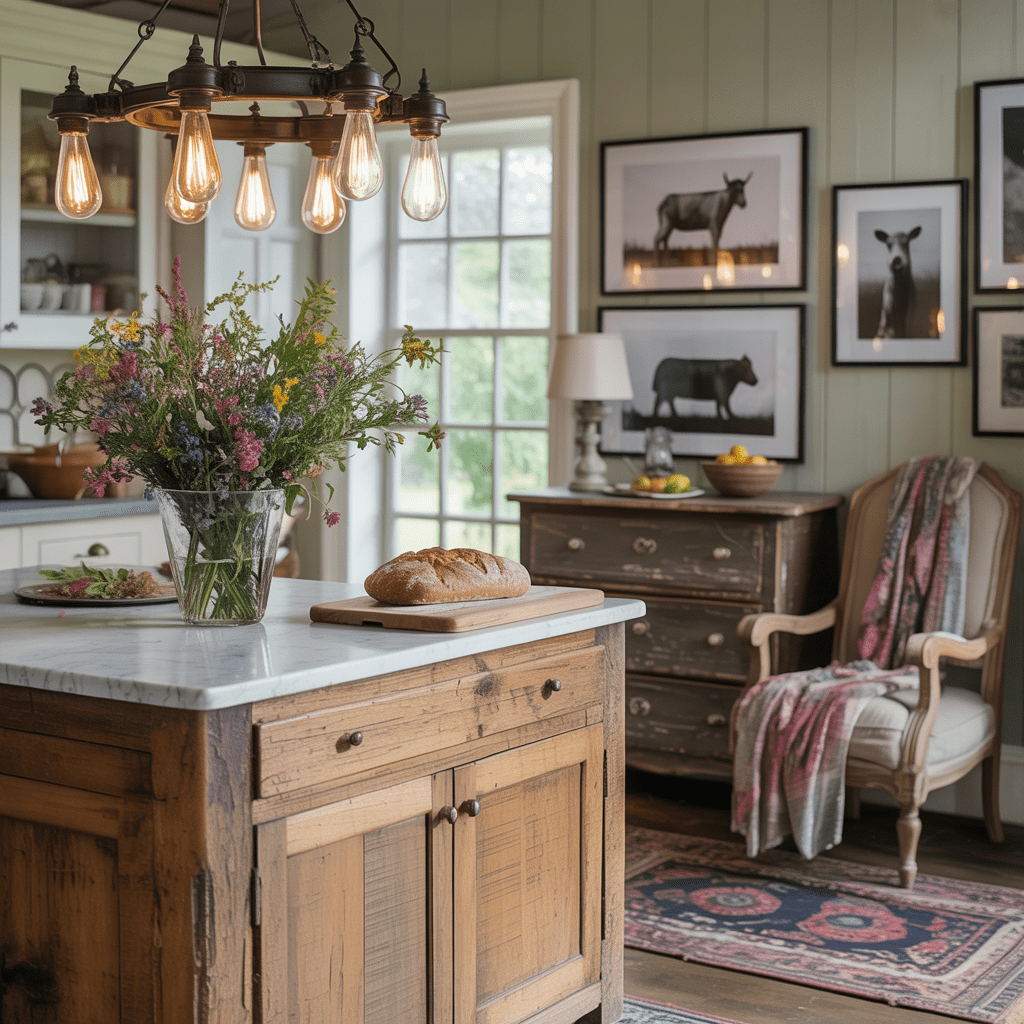
Cottage style celebrates collections and layered decor, which can trick us into thinking every surface needs to be styled. But here’s what actually happens: when every single surface is occupied, your eye has nowhere to rest. Instead of feeling cozy, the room feels busy and overwhelming.
I learned this the hard way with my coffee table. I had a tray with candles, a stack of books, a small vase, and a decorative box. It looked cute in isolation, but it made the entire room feel crowded because it was competing with similarly styled end tables, a full mantel, and decorated shelves.
The Fix:
Adopt the “rule of empty” – intentionally leave some surfaces completely bare or with just one simple item. This creates visual breathing room that makes your decorated areas stand out more.
Practical application:
- Coffee table: Style it beautifully, but keep end tables simple (just a lamp, or lamp plus one small item)
- Mantel: Go full cottage charm here, but leave the nearby console table more minimal
- Shelves: Style some shelves fully, but leave some with just books or just one object
- Windowsills: These don’t all need plants or decor. Some can stay empty.
Think of it like punctuation in a sentence. The empty surfaces are the periods and commas that help your eye process the beautiful decorated areas.
Mistake #2: No Clear Color Palette
The Problem:
You found a gorgeous blue floral pillow at HomeGoods. Then a dusty pink throw at Target. That sage green vase was perfect at the thrift store. And don’t even get started on the yellow vintage finds.
Before you know it, your cottage living room has seven different accent colors, none of which really coordinate. Each item is beautiful individually, but together they create visual chaos that reads as clutter even when your room is actually tidy.
This was my bedroom for years. I loved vintage floral linens so much that I bought every pretty set I found, mixing pink roses with blue hydrangeas with yellow daisies with purple lavender. My bed looked like a floral explosion, and not in a good way. The room felt messy even when it was perfectly clean.
The Fix:
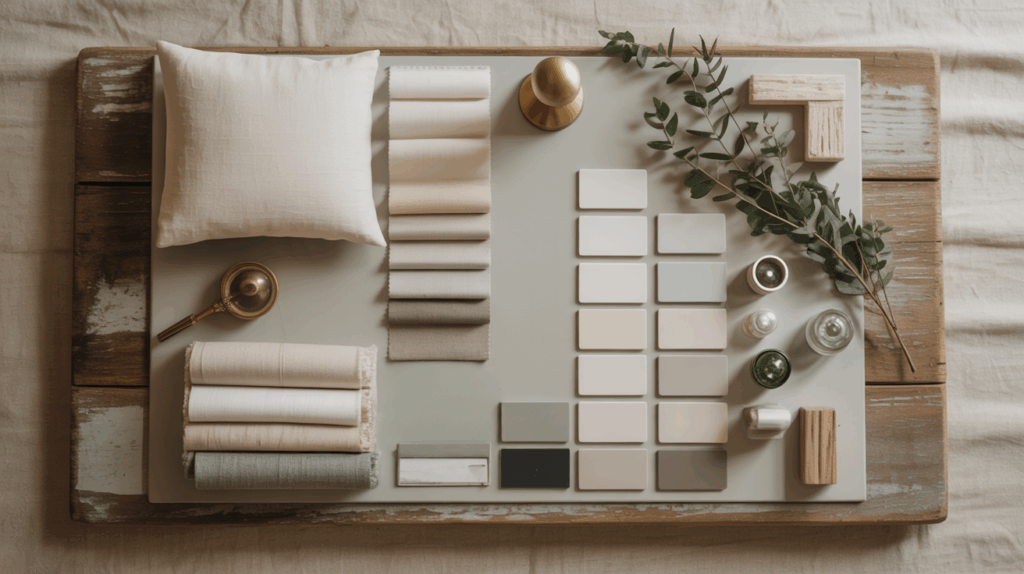
Choose a simple color story and stick to it ruthlessly. Cottage style works beautifully with limited palettes.
My favorite cottage color formulas:
- Classic cottage: Whites and creams with one soft accent color (sage, dusty blue, or soft pink)
- Garden cottage: White base with greens (sage, olive, moss) and natural wood tones
- Coastal cottage: Whites with blues (sky blue, dusty blue, navy) and weathered wood
- Romantic cottage: Creams with blush pink and soft gray-blue
Pick your formula, then edit. That gorgeous coral pillow might be beautiful, but if your room is sage and cream, it’s creating clutter. Donate it or move it to a room where it fits the palette.
Quick color audit: Stand in your room and identify every accent color. If you count more than three (not including white/cream/wood), you probably need to edit.
Mistake #3: Too Many Small Items
The Problem:
Cottage style loves collections – vintage bottles, small vases, ceramic birds, trinket boxes, miniature pitchers. The problem happens when you display fifty small items instead of being selective.
Small objects require your eye to work harder to process them. A shelf full of tiny things makes your brain work overtime, creating that cluttered, anxious feeling. Even if the items are beautifully arranged, too many small-scale pieces create visual noise.
I see this most often on open shelving in kitchens and on bookcases. Every inch is filled with small treasures, and while each piece might be meaningful, together they overwhelm the space.
The Fix:
Embrace larger-scale items and group small items into vignettes rather than spreading them around.
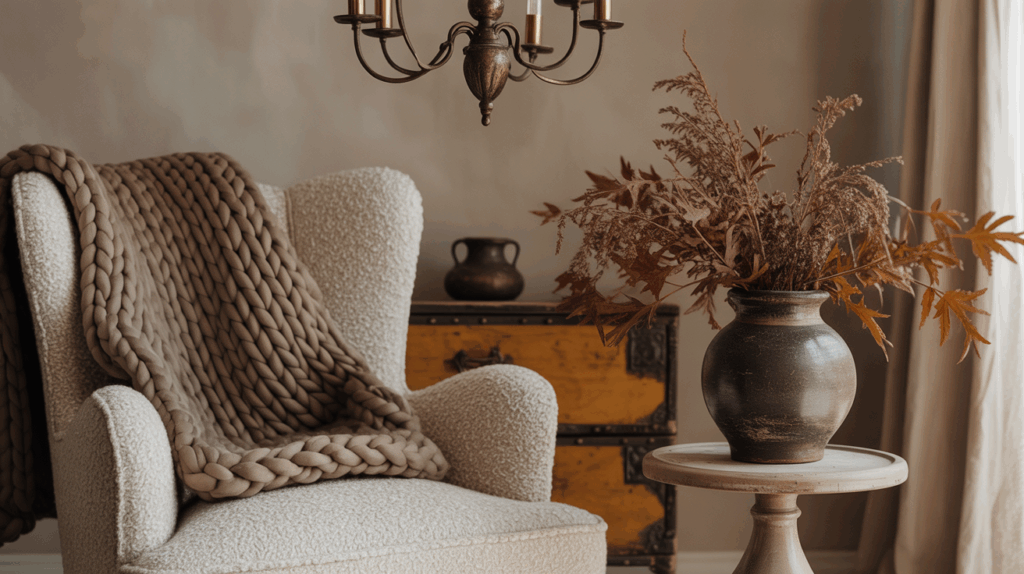
The power of scale: Replace five small vases with one larger statement piece. Instead of eight tiny vintage bottles on a shelf, keep your three favorites and store the rest. Use your small items strategically in tight groupings rather than distributed everywhere.
Grouping strategy:
- Collect small items on trays (this contains them visually and physically)
- Create one small-item vignette per room rather than scattering them
- Use larger vessels (bowls, boxes, baskets) to corral small loose items
- On shelves, alternate between larger statement pieces and small grouped collections
Before and after example from my kitchen: Before: 15 small white pitchers spread across three shelves After: 3 larger pitchers on display, the rest stored in a cabinet and rotated seasonally
The difference was dramatic. The room instantly felt more intentional and less chaotic.
Mistake #4: Mixing Too Many Pattern Styles
The Problem:
Florals, stripes, checks, toile, chintz, damask, plaids, geometrics – cottage style can incorporate all of these patterns, but not all at once in the same space.
I learned this lesson with throw pillows. I had a floral pillow, a buffalo check pillow, a striped pillow, a geometric pillow, and a toile pillow all on one sofa. Each pillow was lovely on its own. Together, they fought for attention and made my simple white sofa look chaotic.
Pattern mixing is an art, and when done wrong, it creates instant visual clutter even if you only have a few items.

The Fix:
Limit yourself to 2-3 pattern types per room, and make sure they share a common element (color, scale, or style).
Cottage pattern formulas that work:
- Classic: Floral + stripe (in the same color family)
- Casual: Check + ticking stripe
- Romantic: Two floral patterns in different scales (large + small)
- Neutral: Textured solids + one subtle pattern
Pattern mixing rules:
- Vary the scale (one large pattern, one medium, one small)
- Keep the color palette consistent across all patterns
- Use more solids than patterns (60% solid, 40% pattern is a good ratio)
- Stick to patterns that share a similar style (all traditional, or all casual, not mixed)
My current living room pattern mix:
- Sectional: gray-brown slipcover
- Pillows: olive green linen, solid gray, textured cream
- Rug: dark gray and cream distressed pattern
- Natural wood furniture pieces
- Green plants for organic texture
Everything works together because the color palette is tight – grays, greens, creams, and natural wood tones. The rug provides the only real pattern, while everything else is solid textures. The green plants bring life without adding visual chaos.
Mistake #5: No Negative Space on Walls
The Problem:
Gallery walls, floating shelves, wall-mounted hooks, mirrors, art, wreaths, wall sconces – cottage style walls can be wonderfully layered. But when every wall is decorated and there’s no blank space, the room feels claustrophobic and cluttered.
Negative space (empty wall area) is just as important as decorated space. It gives your eye permission to rest and makes the items you do display more impactful.
I see this mistake most often in living rooms and bedrooms where people feel pressure to “finish” decorating by filling every wall. But a room with one well-styled wall and three simpler walls feels more intentional than a room where all four walls compete for attention.

The Fix:
Embrace empty wall space as a design element, not a problem to solve.
Wall decoration strategy:
- Choose one “statement wall” per room for your gallery wall, shelves, or layered decor
- Keep other walls simple – maybe one piece of art or even completely bare
- Create visual weight on lower levels (furniture, floor decor) so walls don’t have to do all the work
- Use the “stand back test” – if you can’t take in the whole wall at a glance without your eyes darting around, it’s too much
My bedroom example:
- Wall behind bed: simple white wood board and batten, one piece of art centered above
- Side walls: completely bare white
- Wall opposite bed: floating shelves with curated styling
The restraint on three walls makes the decorated wall feel special rather than competing for attention.
Quick wall audit: Stand in the center of each room and slowly turn 360 degrees. How many walls have significant decoration? If it’s more than two walls per room, consider editing.
The Real Secret to Cozy (Not Cluttered) Cottage Style
After all these years, I’ve realized that the difference between cozy cottage and cluttered cottage comes down to one thing: intentional editing.
Cottage style isn’t actually about having more stuff. It’s about curating what you display and being selective about what earns a place in your home. Every item should either be beautiful, useful, or meaningful – ideally all three.
My editing process when a room feels cluttered:
- Remove everything from surfaces and walls (yes, everything)
- Put back only what you love most – usually about 50% of what was there
- Live with it for a week before adding anything back
- Add back selectively only if you feel the space needs it
You’ll be shocked how much better the room feels with less. And here’s the interesting part: guests often comment that the room looks more decorated after I’ve removed things, not less. Because what remains gets to shine.

When “Cottage Clutter” Is Actually Working
I should mention: there’s a difference between cluttered and collected. Some cottage spaces are wonderfully full and layered and absolutely work. How can you tell the difference?
A room is successfully full (not cluttered) if:
- You can identify the color palette immediately
- Your eye travels smoothly around the room rather than bouncing frantically
- There’s at least some empty surface space
- Everything looks like it belongs together, even if it’s mismatched
- The room feels like an invitation rather than an assault
- You can clean it in under 15 minutes
A room has crossed into clutter if:
- You can’t identify what style or color story it’s supposed to be
- Looking at it makes you feel stressed or overwhelmed
- You regularly can’t find things because of all the visual noise
- Guests’ eyes don’t know where to land
- Dusting takes forever because of so many small items
- You catch yourself saying “I should organize this” every time you enter
Your Decluttering Action Plan
If you recognized your home in any of these mistakes, don’t panic. You don’t need to start over. Here’s what I’d do today:
For the next 30 minutes:
- Clear off 3 surfaces completely (coffee table, one side table, one shelf)
- Remove any decor items that don’t fit your color palette
- Take down wall decor from one wall (store it, don’t throw it away yet)
- Box up half your small decorative items to rotate seasonally
Live with these changes for one week.
I’m willing to bet you’ll find the room feels better, not worse. More peaceful, more intentional, more like the cottage aesthetic you were going for in the first place.
The beauty of cottage style is that it’s meant to evolve. It should be forgiving, comfortable, and collected over time. But “collected” doesn’t mean “everything displayed all at once.” Some of our best treasures deserve to be stored away and rotated seasonally, giving us something fresh to look forward to.
Your cottage should feel like a deep breath, not a held breath. And sometimes that means loving your things enough to let them rest in a cabinet for a while.
Now if you’ll excuse me, I just spotted seven small items on my kitchen counter that definitely need to be edited down to three. Because apparently I still need to take my own advice.
What mistake resonated most with you? I’d love to hear which one you’re tackling first – drop a comment below and let’s hold each other accountable to keeping that line between cozy and cluttered right where it belongs.


I just feel like you give so many rules! In our home, I designed an addition with a 22′ X 40′ keeping room with 12′ vaulted ceilings. It is open concept and includes a dining area and kitchen that I decorated in what I would call french country style. I chose burgundy as an accent color and sage green and light gold as complementary colors. The neutrals are medium stained wood tones and cremes. In addition, I have floral pillows on matching burgundy striped love seats and a large solid sage green couch. I have window seats that contain cushions the same sage green material as the couch and they have multiple patterns of pillows that compliment each other. All four walls have accent features as focal points – #1 fireplace flanked by windows with seats, #2 set of four french doors out to an enclosed porch, #3 barn doors opening to my office, #4 kitchen cabinets with decorative arched hood over cooktop. All other wall spaces have various decorations, differentiatiing in size in proportion to the wall space. According to your “rules,” this room would be cluttered because when you look around the room, each wall has its own focal point flaked by smaller enhancing decorations. When guests or family come into the room, they have an attractive wall to look at wherever they sit and I believe that is more important than only choosing one feature wall. What if the only feature wall is behind them? While socializing, people don’t constantly gaze around a room like you describe. They sit and are interacting with the hosts and viewing the wall that is in front of them. Keeping this in mind is truly decorating to be pleasing to your guests. Your color palates are subjective and not my taste. Forget all the “rules” – the important thing is to create an atmosphere where your guests feel at home. And that is what I have been told my keeping room does.
It sounds like you know your style and have used it in your own home. This is what turns our houses into homes. A lot of homeowners and/or renters are looking for guidance to begin to decorate and discover their style.
Guidelines are just a starting place, not a rulebook. The suggestions I share are meant to give people a foothold — a way to make decisions without feeling overwhelmed. Once they find their footing, they’re absolutely free to throw out every guideline and create something uniquely their own.
Your point about decorating for your guests — making sure there’s something beautiful to look at from wherever they’re seated — is a lovely way to think about it. At the end of the day, that’s the whole goal. A space where people feel welcome and at home is a successful one, whatever path gets you there.